The History of Photography
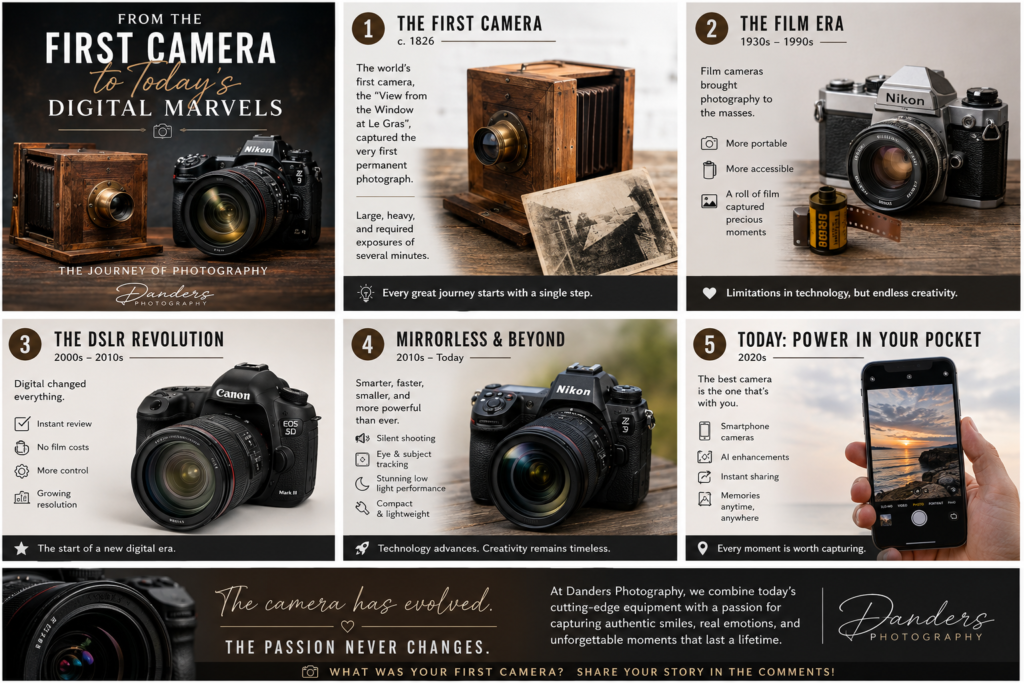
From the First Camera to Today’s Digital Marvels
Photography has transformed dramatically over the past two centuries. What began with large wooden boxes, fragile materials, and extremely long exposure times has evolved into powerful digital cameras capable of capturing thousands of detailed images in seconds.
Although the equipment has changed, the purpose of photography remains the same: to preserve important people, emotions, places, and moments for generations to come.
1. The First Cameras
The earliest cameras were very different from the cameras we recognize today. They were large, heavy wooden devices that required careful preparation and plenty of patience.
Early photographs could take several minutes—or even longer—to capture. Subjects had to remain completely still, which is why people in old photographs often appeared serious and rarely smiled.
Images were produced on materials such as metal plates, glass, and specially prepared surfaces. Each photograph was precious because the process was expensive, delicate, and difficult to repeat.
These early inventions laid the foundation for everything photographers use today.
2. The Rise of Film Photography
As camera technology improved, photography became more portable and accessible.
Film cameras allowed photographers to take multiple photographs on a single roll of film. Families could document birthdays, holidays, weddings, vacations, and everyday life without needing complicated equipment.
However, film photography still required patience. Photographers could not immediately see the images they had taken. The film had to be developed before anyone knew whether the photograph was properly exposed, sharply focused, or captured at the perfect moment.
This made every press of the shutter feel important.
Film photography taught photographers to slow down, observe carefully, and think before taking each photograph.
3. The DSLR Revolution
Digital photography changed everything.
Digital single-lens reflex cameras, commonly known as DSLRs, removed the need for rolls of film. Photographers could instantly review their images on the back of the camera and adjust their settings when necessary.
Digital cameras offered several major advantages:
- Instant image review
- No film-development costs
- Greater control over exposure and focus
- The ability to capture hundreds or thousands of photographs
- Improved image quality and resolution
- Faster editing and delivery
The DSLR era made professional photography faster, more flexible, and more reliable.
Photographers could experiment more freely, capture spontaneous moments, and provide clients with a wider selection of images.
4. Mirrorless Cameras and Modern Photography
Mirrorless cameras represent another major advancement in photography.
These cameras are often smaller and lighter than traditional DSLRs while still offering outstanding professional image quality. They also include advanced features that help photographers work quickly and accurately.
Modern camera technology may include:
- Eye and subject-tracking autofocus
- Silent shooting
- Excellent low-light performance
- High-resolution image sensors
- Fast continuous shooting
- Powerful image stabilization
- Advanced video capabilities
- Compact and lightweight camera bodies
These tools allow photographers to concentrate less on technical limitations and more on creativity, storytelling, and emotion.
Technology helps photographers capture moments that may have been difficult or impossible to photograph in the past.
5. Photography in Your Pocket
Today, almost everyone carries a camera.
Smartphones have made photography part of everyday life. People can photograph a special moment, edit it, and share it with friends and family within seconds.
Smartphone cameras include features such as automatic enhancements, portrait modes, night photography, image stabilization, and instant sharing.
They are excellent for documenting daily life and spontaneous memories.
However, professional photography offers something more than simply taking a picture.
A professional photographer understands lighting, posing, composition, location, timing, editing, and emotional storytelling. Professional equipment also provides greater control, sharper detail, better performance in difficult conditions, and high-quality images suitable for printing and display.
The Camera Has Evolved, but the Passion Has Never Changed
From wooden cameras and glass plates to film, digital cameras, mirrorless systems, and smartphones, photography has experienced an extraordinary journey.
Yet the most important part of photography has never been the equipment.
A meaningful photograph depends on the person behind the camera—their creativity, patience, experience, and ability to recognize a moment worth preserving.
The best photographs do more than show what someone looked like.
They remind us how a moment felt.
Photography at Danders Photography
At Danders Photography, we combine modern camera technology with a relaxed, personal, and creative approach.
We believe photography should be enjoyable, comfortable, and meaningful. Our goal is to capture authentic smiles, genuine emotions, natural connections, and unforgettable moments.
Whether we are photographing a family, a couple, an individual portrait, a mini session, or a special event, every session is created with care and attention.
Technology allows us to capture incredible detail, but passion, creativity, and human connection are what bring each photograph to life.
Preserve Your Story
Cameras will continue to change, and technology will continue to improve.
The moments we capture, however, will always remain important.
Your photographs become part of your family’s history. They allow future generations to see the people you loved, the milestones you celebrated, and the memories that helped shape your life.
The camera has evolved.
The passion never changes.
Discover professional photography sessions with Danders Photography and create memories that will last a lifetime.
Visit www.danders.ca to learn more or book your photography session.